Nobody invented dice. The history of dice starts with the ankle bones of hoofed animals, rolled for fortune-telling and games long before writing, and the oldest dice found so far are about 5,000 years old: bone dice from Skara Brae in Scotland dated to 3100 to 2400 BCE, and dice in a game set at the Burnt City in Iran from 2800 to 2500 BCE. Four-sided dice rolled at Ur, Romans gambled with cubes numbered 1 to 6, and twenty-sided dice turn up in Egypt by the 2nd century BCE.
The 7-piece polyhedral set is the newest chapter, and it started in the late 1960s. See it for yourself in our Retro Holmes replica, which reproduces the dice from the 1977 Dungeons & Dragons Basic Set, crayon and all. Here is how we got from bones to that box.
| Date | Find | Where |
|---|---|---|
| From about 5000 BCE | Animal ankle bones (astragali) turn up in digs far more often than other bones | Many sites |
| 3100 to 2400 BCE | Bone dice | Skara Brae, Scotland |
| About 5,000 years ago | Dice and 49 carved game pieces in a Bronze Age burial | Başur Höyük, Turkey |
| 2800 to 2500 BCE | Dice in a backgammon-like game set | Burnt City (Shahr-e Sukhteh), Iran |
| Early 3rd millennium BCE | Royal Game of Ur, played with four-sided dice | Mesopotamia |
| 2500 to 1900 BCE | Terracotta dice, one with opposite sides adding to seven | Mohenjo-daro, Indus Valley |
| 2nd century BCE | Twenty-sided dice | Ptolemaic Egypt |
| Late 1960s | Polyhedral dice catch on with wargamers | Hobby tables |
| 1977 | Holmes Basic Set puts polyhedral dice in an introductory D&D box | TSR |
Who invented dice?
No one person did, and the origin of dice is uncertain. The leading idea is that dice grew out of fortune-telling with knucklebones. The ancient Greeks told their own story: Sophocles credited the invention of knucklebones to Palamedes, who supposedly taught the game to the Greeks during the Trojan War. It is a myth, but it shows how old the question already was.
Dice may also be far older in the Americas. Native Americans of the Great Plains are speculated to have used dice for at least 12,000 years, according to Wikipedia's history of dice.
Knucklebones: the first dice were bones
The earliest dice were animal bones. The talus, or astragalus, is an ankle bone from a sheep or goat. It is almost symmetrical and can only come to rest on four of its sides, which makes it a natural random number generator. Archaeologists find these bones in digs from about 5000 BCE onward much more often than other bones. The Greeks played knucklebones as a game of skill, and a later version gave each of the four sides a different value, the way modern dice do.
The game never went away. Children in many cultures still play jacks and fivestones, descendants of the same bones. In Central Asia the bones themselves stay in play: Mongolians call them shagai, and Kazakhs call them asyk.

The oldest dice ever found
Dice have been used for at least 5,000 years, and the oldest ancient dice found so far cluster around 3000 BCE, from Scotland to Iran.
Skara Brae, Scotland. Bone dice from this Orkney village are dated to 3100 to 2400 BCE.
Başur Höyük, Turkey. At a 5,000-year-old Bronze Age burial site in Siirt Province, a team led by Haluk Sağlamtimur of Ege University found 49 small stone pieces carved in various shapes, including pigs, dogs and pyramids, painted green, red, blue, black and white. "We also found dice," Sağlamtimur said. The pieces are believed to be a game set.
The Burnt City, Iran. Shahr-e Sukhteh, a Bronze Age city in south-eastern Iran that burned down three times before it was abandoned, gave up possibly the oldest known dice, part of a backgammon-like game set estimated at 2800 to 2500 BCE.
Indus Valley dice and the rule of seven
Graves at Mohenjo-daro, an Indus Valley city, held terracotta dice from 2500 to 1900 BCE. At least one of them has opposite sides that add up to seven, the same rule your d6 follows today. Dice games also appear in ancient Indian texts, including the Rigveda, the Atharvaveda and the Mahabharata.
The colors have deep roots too. Asian-style dice paint the one and the four red, and the red four may be of Indian origin. Even the layout differs by region: with the one, two and three around a shared corner, Western dice run counterclockwise ("right-handed") and Chinese dice usually run clockwise.

Pyramid dice at Ur and throwsticks in Egypt
The Royal Game of Ur was played in Mesopotamia from the early third millennium BC, with four-sided, tetrahedron-shaped dice. Two of the four corners on each die are marked, and you count the marked tips that land facing up. Sir Leonard Woolley found five boards while excavating the Royal Cemetery at Ur between 1922 and 1934, and boards have since turned up from Crete to Sri Lanka. Four game boards found in the tomb of Tutankhamun came with small boxes for dice and pieces.
In ancient Egypt, senet, played before 3000 BCE and into the 2nd century CE, used flat throwsticks, in effect two-sided dice, to set the count. They did the same job: tell you how many squares to move. For the board games themselves, read our history of board games, from Senet to Catan.
Roman tali and tesserae
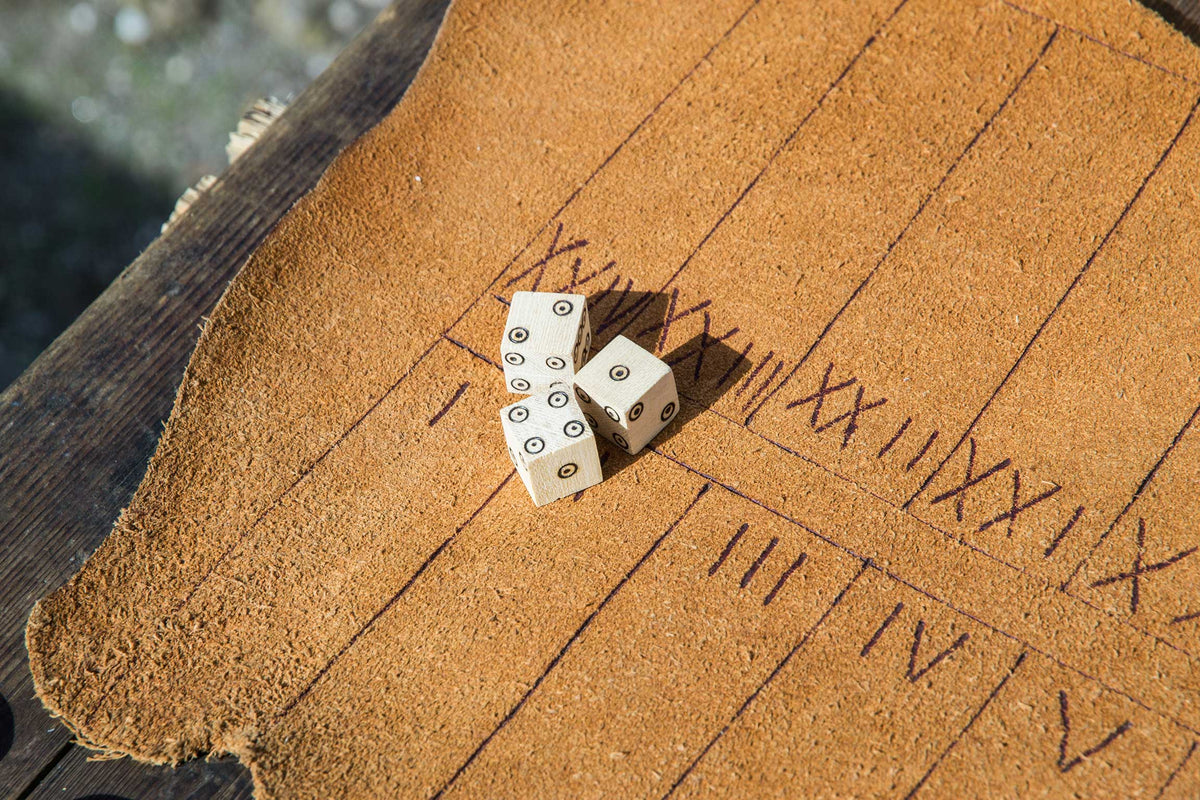
Gambling was illegal in Rome, and Romans diced anyway; they called it aleam ludere, "to play at dice." Roman dice came in two kinds. Tali were large dice marked with one, three, four and six on four sides, a direct descendant of the ankle bone. Tesserae were smaller six-sided dice numbered one to six, close to the d6 in your bag. The first die you ever rolled probably follows the same pattern. Roll two of them in CATAN and 7 comes up most often, as our CATAN dice odds show.
The word comes down from the same world. "Die" comes from Old French dé, from Latin datum, "something which is given or played." Table slang came much later: the Online Etymology Dictionary traces "snake eyes," a pair of ones, back to 1919, and two sixes are "boxcars."

The first twenty-sided dice
The d20 is older than most players guess. Twenty-sided dice date back to Ptolemaic Egypt as early as the 2nd century BCE and turn up again in the 2nd century CE. Dice also changed games in other ways: in China, dominoes and playing cards developed from dice, with the shift to cards around the Tang dynasty (618 to 907 CE). In Japan, dice drove sugoroku: ban-sugoroku, a backgammon-like game from the Heian period (794 to 1185 CE), and e-sugoroku, a race game.
From wargames to D&D: the polyhedral set
The modern habit of owning a set of polyhedral dice started around the end of the 1960s, when wargamers took to non-cubic dice. Dungeons & Dragons is largely credited with popularizing them in role-playing games, and today's standard set is seven dice: d4, d6, d8, d10, a percentile d10, d12 and d20. Our guide to the seven D&D dice explains each one.
The 1977 Holmes Basic Set put a set of polyhedral dice in an introductory D&D box, and players colored the numbers in with a crayon. We tell that story, and how we rebuilt the set for the 50th anniversary, in our post on the Holmes dice. Our replica comes with unpainted numbers and a crayon, just like the original.
History also made it inside the dice. Our Roll with History dice, made with Mini Museum, seal a real specimen in each die, from a fragment of the Campo del Cielo meteorite to a ring of 15th-century chain mail. When you want a set of your own, start with our DnD dice.


Dice history questions
When was the first dice ever made?
Nobody knows exactly. The oldest dice found so far date to around 3000 BCE, including bone dice from Skara Brae in Scotland (3100 to 2400 BCE) and dice from the Burnt City in Iran (2800 to 2500 BCE). Knucklebones used like dice are older still.
Why are 1 and 4 red on a dice?
Asian-style dice color the one and the four red, and the pips sit closer to the center of the face. The red four may be of Indian origin.
Why is a dice called a dice?
The word die comes from Old French dé, from Latin datum, meaning "something which is given or played." Dice is the plural, though many people use it for one.