CATAN dice are two ordinary six-sided dice, so every roll lands between 2 and 12, and 7 comes up most often: 6 of the 36 ways two dice can fall add up to 7, about 16.7% of rolls. Next come 6 and 8 at 5 in 36 each, about 13.9%, and the rarest are 2 and 12 at 1 in 36, about 2.8%. The dots on each number token show those odds.
Add our CATAN Inclusion Dice Set to your game shelf, or read on for the full odds table, what a 7 does, and the robbers and metal dice we make for CATAN.
CATAN dice odds for every number
Two dice give 36 equally likely results, counting a 1 and a 3 as different from a 3 and a 1. The chance of any sum is the number of ways to make it, divided by 36:
| Sum | Ways out of 36 | Chance | Dots on the token |
|---|---|---|---|
| 2 | 1 | 2.8% | 1 |
| 3 | 2 | 5.6% | 2 |
| 4 | 3 | 8.3% | 3 |
| 5 | 4 | 11.1% | 4 |
| 6 | 5 | 13.9% | 5 |
| 7 | 6 | 16.7% | No token: the robber moves |
| 8 | 5 | 13.9% | 5 |
| 9 | 4 | 11.1% | 4 |
| 10 | 3 | 8.3% | 3 |
| 11 | 2 | 5.6% | 2 |
| 12 | 1 | 2.8% | 1 |
A Stanford page on CATAN dice odds walks through the same math, and points out that in some editions the dots on the number tokens match these odds exactly: one dot on 2 and 12, two on 3 and 11, and so on up to five on 6 and 8.
How to use the odds when you place settlements
Each settlement touches up to three terrain hexes, so add the dots on their tokens to see how often the spot pays. A spot on a 6, an 8 and a 5 has 5 + 5 + 4 = 14 dots, so 14 of every 36 rolls, about 39%, give that settlement something. A spot on a 2, a 12 and a 3 has 4 dots, about 11% of rolls.
Cities double the payout. A city takes two resource cards when its number rolls, where a settlement takes one, so upgrading the settlement on that 14-dot spot doubles its resource production on the same 14 rolls in 36.
Dots also help you spread out. Two settlements on the same 6 both pay on a 6 and both go quiet when it doesn't roll, while settlements on different numbers pay on more turns. Odds describe the long run, though: over 36 rolls you would expect about six 7s, and a short game can still run hot or cold on any number.
That is the honest answer to whether CATAN is luck or skill: the dice decide which numbers pay each turn, and players decide where to build, what to trade and where to send the robber. Knowing the odds is how you make the dice work for you more often than against you.

What happens when you roll a 7
Seven has no number token because it belongs to the robber, which starts the game on the desert hex. When anyone rolls a 7, three things happen:
- Big hands shrink. Every player holding 8 or more resource cards discards half, rounded down, so a player with 9 cards gives up 4.
- The robber moves. The player who rolled moves the robber to another hex, and that hex produces nothing until the robber moves again.
- Someone may lose a card. The roller may steal a resource card from a player with a settlement or city next to the robber's new hex.
A knight card moves the robber too, as if you had rolled a 7 but without the discard, and playing the most knight cards earns the Largest Army; building the longest road earns the Longest Road, and both are worth extra victory points. These rules follow CATAN's Wikipedia entry. With 7 the most likely roll, holding 8 or more cards at the end of your turn is a risk on every roll.
The odds also tell you where the robber hurts most. It is your main tool for slowing your opponents: parked on a 6 or an 8, it takes away 5 rolls in 36 of production from every settlement and city on that hex until someone moves it.

Our CATAN gemstone robbers and metal dice
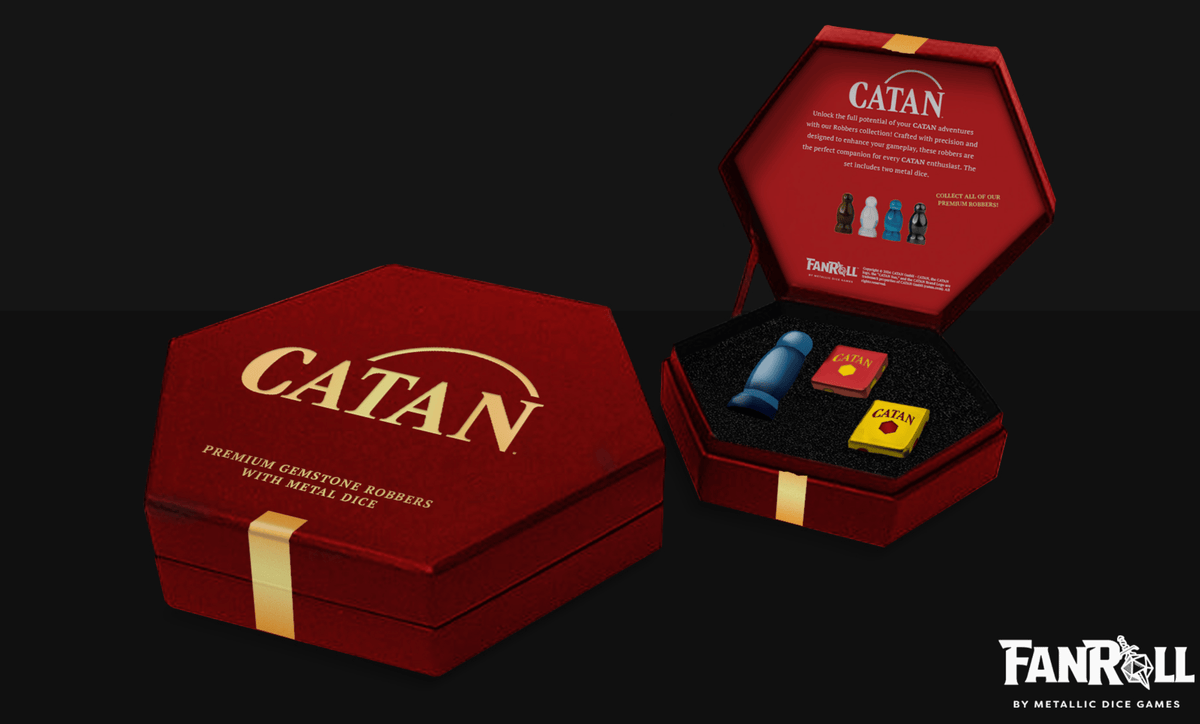
Our CATAN Premium Robber and Metal Dice sets swap the plastic robber for one made of stone and add a pair of solid metal dice forged in the official CATAN dice mold. There are four stones to collect: Hematite, Tiger's Eye, Opalite and Cat's Eye Aquamarine. An Amethyst set was a Gen Con exclusive. Each set comes in a red hexagon box.
Metal dice weigh more than resin dice, so roll them on a mat or a tray to spare the board and the table. Our post on how much dice weigh compares resin, gemstone and metal.


CATAN inclusion dice
Our CATAN Inclusion Dice Set seals the resources of CATAN inside oversized dice and comes in a hexagon case. They are collectible pieces for your game shelf as much as dice for the table. For how inclusion dice work and what else we put inside them, see our guide to inclusion dice, and for the bigger project, read about the CATAN Masterpiece Series.

Where CATAN and its dice came from
Klaus Teuber designed CATAN, which was first published in Germany in 1995 by Kosmos and was long known in English as The Settlers of Catan. A separate CATAN Dice Game came out in 2007. Our history of board games shows where CATAN sits next to Senet and D&D, and our history of dice goes back to the first six-sided cubes. For the rest of what we make, start at our DnD dice.
CATAN dice questions
What is the most common roll in CATAN?
7. Six of the 36 ways two dice can land add up to 7, about 16.7% of rolls, and a 7 moves the robber instead of producing resources.
What happens when you roll a 7 in CATAN?
Players holding 8 or more resource cards discard half, rounded down. The roller moves the robber to a new hex, which stops producing, and may steal a card from a player next to it.
What is the CATAN Dice Game?
A separate game in the CATAN family, released in 2007. It is not the same as rolling the two dice in the CATAN board game.