How much does a dice weigh? For a full seven-piece 16mm set, FanRoll records 1 ounce (28 g) for resin, 4 ounces (113 g) for gemstone and 8 ounces (227 g) for metal, so a single metal die weighs about eight times what a resin die does. Those listed weights are rounded to the ounce, and they are the difference you feel in the hand before the dice ever hit the table.
Shop metal dice sets if weight is the point: every full 16mm set in that collection is listed at 8 ounces.
What a dice set weighs, material by material
The table uses the weight FanRoll records for each full set in its catalog, read on October 21, 2026. Shopify rounds those entries to the nearest ounce, so the per-die column is an average, not a scale reading.
| Set (16mm unless noted) | Listed weight per set | About per die | What that means at the table |
|---|---|---|---|
| Resin or acrylic | 1 oz (28 g) | 4 g | Lightest, bounces and rolls the farthest |
| Liquid core | 4 oz (113 g) typical, listed between 3 and 6 oz by set | 16 g | Resin shell around a liquid chamber, heavier than plain resin |
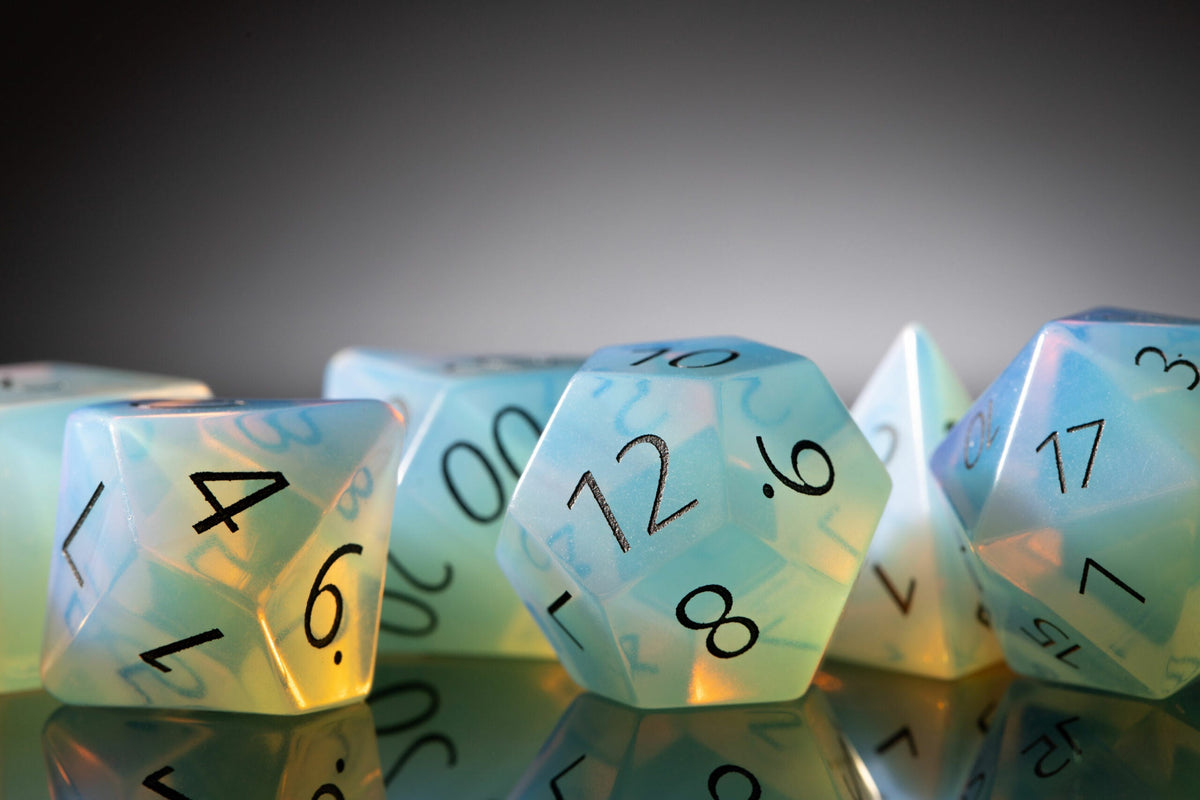
| Gemstone | 4 oz (113 g) | 16 g | Stone, so roll it on a padded surface |
| Metal | 8 oz (227 g) | 32 g | Cast zinc alloy, shortest roll, loudest landing |
| 10mm mini resin | listed at the 1 oz minimum | under 4 g | Fits a small bag or a pocket |
Sharp-edge silicone sets sit in the resin row at 1 ounce, and the Dragon Storm silicone sets are listed at 4 ounces, so check the product page for any set that mixes materials. Why edges matter is covered in the allure of sharp edge dice.

Why metal dice weigh more
FanRoll's metal sets are cast from solid zinc alloy and then plated or enameled, which is why a 16mm metal d20 lands with a thud where a resin d20 skitters. The same shape holds far more mass when it is metal instead of plastic, and that mass is what players mean by heft. The oversized dice, from 25mm sets to the 55mm mammoth d20, are in the Mega collection.
The weight has two practical effects. A metal die stops sooner, which keeps rolls on the table, and it can mark a bare wooden surface, which is why FanRoll's own product pages recommend rolling metal dice on a padded tray. A fold-flat dice tray solves both problems for the whole table. Our CATAN robber sets pair a stone robber with solid metal dice forged in the official CATAN dice mold, and our CATAN dice post has the odds for every roll.
Does a heavier die roll any differently?
Heavier dice travel a shorter distance for the same throw and settle faster. That is a feel preference, not a fairness one: a fair die of any weight lands on each face equally often over enough rolls, because the mass is spread evenly through the shape.
A weighted or loaded die is a different thing. Wikipedia's entry on dice describes loaded dice as dice that have been tampered with so one face comes up more often, through rounded faces, off-square faces or hidden weights. Heavy is not the same as loaded. A solid metal die is heavy all the way through.

Standard dice sizes, from 10mm to 55mm
Size changes weight faster than material does, because the volume of a die grows with the cube of its width. FanRoll's range covers these sizes:
- 10mm mini sets, the smallest full seven-piece sets, made for travel and for crowded tables.
- 16mm sets, the standard size for Dungeons & Dragons and most tabletop games, and the size every weight above refers to.
- 22mm oversized d6s, the size used in the Monopoly dice set.
- 25mm giant sets, such as the Castle resin set, listed at 4 ounces for seven resin dice.
- 55mm mammoth d20s, a single display-size die listed at 1 ounce in resin.
If you are choosing a first set and size matters more than weight, the guide to DnD dice on the homepage and the post on how to pick a dice set walk through the options by material.

How to weigh and check your own dice
A kitchen scale that reads in grams is enough. Weigh the full set first, then each die, and compare the numbers with the table above. Resin dice in the 3 to 5 gram range and metal dice around 30 grams are where FanRoll's listed weights put them.
- Weigh the d20 on its own. It is the largest die in the set and the one most players care about.
- Check the numbers are centered and the faces are flat. A die that rocks on a flat table has an uneven face.
- Store stone and metal apart from resin. Heavy dice chip lighter ones in a shared bag, which is why the dice bag guide suggests compartment bags for mixed collections.
Which weight is right for you?
Pick by how and where you play, not by the biggest number.
New players, travelers and anyone who games at a crowded table do best with resin or a 10mm mini set. A full resin set weighs about as much as a letter, it survives a drop onto a hard floor, and a spare set costs little enough that a club can keep extras in the bag.
For a club at school, our post on D&D in schools covers what Wizards offers and what the research found.
Players who want the thud choose metal and add a tray. The 8 ounce set is the one people pass around the table, and the D&D liquid core set, listed at 6 ounces, gets close to that heft while keeping the swirl of a resin core. Both are the sets that make a critical hit sound like one. FanRoll's liquid core sets are hand-polished sharp edge dice.
Collectors and gift buyers lean toward gemstone. A stone set weighs half what metal does, each die cuts differently, and it needs the same padded tray plus its own pouch. Our Pride velvet dice trays are padded the same way, in nine flags. If you are unsure which set to pick, hold one of each at a game store before you decide, since the feel in the hand is the whole question.
Caring for heavy dice
Metal needs the least care: wipe it down and keep it off bare wood. Gemstone needs the most, because stone can chip on a hard landing, so gemstone dice belong on a padded tray and in their own pouch. Resin and liquid core dice take a damp cloth and nothing abrasive, which the post on dice care covers step by step. Care by material is covered in caring for premium dice.
Dice weight questions
How much does a d20 weigh?
It depends on the material. Working from FanRoll's listed set weights, a 16mm resin d20 comes to about 4 grams, a gemstone d20 to about 16 grams and a metal d20 to about 32 grams. The d20 is the biggest die in a seven-piece set, so it sits a little above those averages.
Are metal dice too heavy for a dice tray?
No. A padded tray is where metal dice belong. FanRoll recommends padded surfaces for any metal die, because an 8 ounce set dropped on bare wood can dent the table and ding the dice. The tray also stops the shorter, heavier roll from leaving the playing area.
How much does a dice weigh in grams?
A full 16mm set is listed at 28 grams in resin, 113 grams in gemstone or liquid core, and 227 grams in metal. Divide by seven for a rough per-die figure: about 4, 16 and 32 grams.