

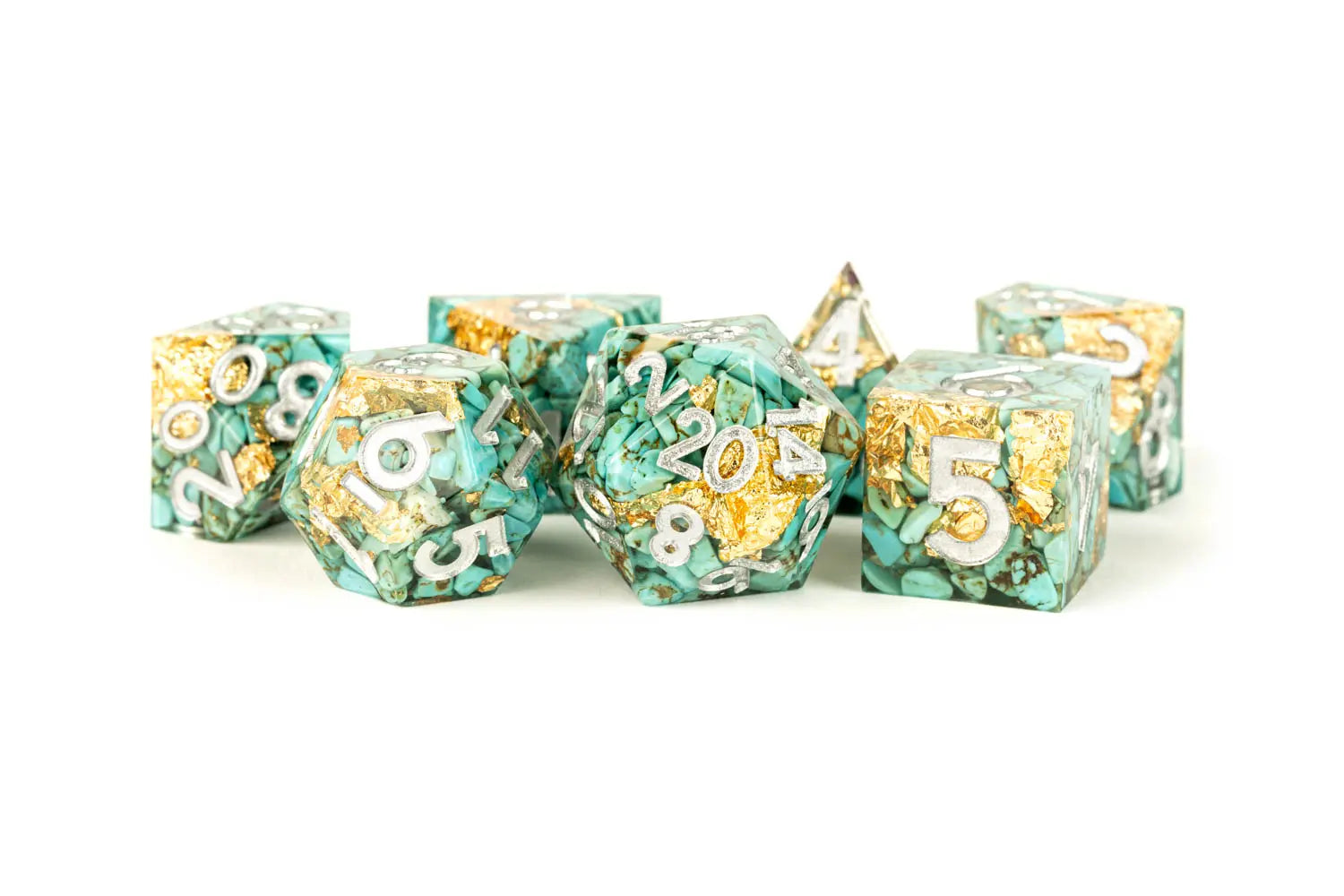
Sharp edge dice are dice whose flat faces meet at crisp, square edges and pointed corners, instead of the soft, rounded edges you see on most mass produced sets. Put one next to a standard d20 and you see it right away. The sharp one looks cut. The round one looks worn smooth.
That look is a big part of the appeal. But the edge also changes how a die is made, how it feels in your hand, how it moves when you roll it, and how you should treat it. This guide is for D&D players and dice collectors deciding whether a sharp edge set is worth it. We cover how they are made, how they compare to rounded dice, whether they roll fair, and how to keep those edges intact, drawing on what we have learned selling dice since 2014.
What are sharp edge dice?
A sharp edge die keeps the geometry it was cast with. Resin is the most common sharp edge material on the market, cast in precision molds and finished by hand. Most budget plastic dice go through a tumble finishing step that works a lot like a rock polisher. The Wikipedia entry on dice explains that tumbling strips paint from everything but the number recesses, and a finer abrasive then leaves the smoother, rounded edges common on cheap sets.
Our handmade sharp edge resin dice skip the tumbler. Each one is hand polished to keep its beautiful sharp edges. That is the whole trick. It is also why handmade sets cost more than a tumbled set: somebody has to finish every face by hand, right up to the edges around the numbers.
Casino dice are the famous example of the style. Precision dice for craps are cut from bars of cellulose acetate. The pips are drilled and then filled with material that matches the plastic's density, and the edges are usually left sharp, which the trade calls square or razor edge.
Sharp edge vs rounded dice
Here is the honest comparison, side by side.
| Sharp edge dice | Rounded edge dice | |
|---|---|---|
| Edges and corners | Crisp, square edges and pointed corners | Soft, rounded corners |
| How they are finished | Hand polished, not tumbled (our resin sets) | Tumbled in bulk |
| How they move | Corners give them more to catch on | Built to move freely |
| Appearance | Clean lines that show off what is cast inside | Softer, worn look |
| Price | Higher, because of the hand finishing | Usually lower |
The "how they move" row has a real basis. Precision backgammon dice get rounded corners and edges on purpose so they can move inside the dice cup, and so hard throws don't damage the board. Rounding makes a die roll farther. A sharp edge does the opposite and gives the die something to catch on. So the expected result when you roll is simple: a rounded die keeps rolling across the table, and a sharp one catches and settles sooner. If dice that skitter off the table drive you nuts, that matters. Many players also like the feel of a crisp edge between their fingers before the roll.
Do sharp edges make dice more fair?
Our own product pages put it carefully: because sharp edge dice are not tumbled, they are often considered more precise than mass produced resin dice. The casino world shows where the worry comes from. Rules for precision dice allow beveled or rounded edges only if every edge is done evenly and consistently. Uneven rounding is the thing nobody wants.
Balance comes down to manufacturing quality more than edge style. A large air bubble trapped inside, an uneven mold, or too much sanding can throw any die off, sharp or round. Sharp edges alone do not make dice unfair, and they do not make them fair either.
What we will not tell you is that a new set will change your odds. Nobody should promise you more nat 20s, and you should be wary of anyone on the market who does. A true claim is smaller: sharp edges keep the shape the die was made with, and they give you a cleaner look. That is plenty.
Why do casino dice have sharp edges?
Precision casino dice are built to be hard to cheat with. They have sharp corners and edges and flush markings. They are also transparent or translucent, so weighting hidden inside is harder to pull off. Each die carries a serial number and the casino's name or logo, which discourages swapping. Size is regulated too: New Jersey caps a casino die at 0.775 inches on a side.
So the sharp edge on a craps die is about control. The sharp edge on your d20 borrows the same idea and adds a lot more style.
Materials: resin, liquid core and metal
Sharp edges show up in more than one material across our sharp edge dice collection.
Resin. Our hand crafted sharp edge resin sets are the classic pick. They come with glitter flakes, clouds, pebbles and more cast inside, and some carry glow in the dark fill that shows up when the light goes down. The Aqua Pyre set is a good example at $39.99. Each 16mm polyhedral set comes with 7 dice: d4, d6, d8, d10, d10 (00 to 90), d12 and d20. That covers every roll in a standard D&D game. For rounded sets too, see our DnD dice.
Liquid core. Sharp edges and a liquid core can live in the same die. Our Gen Con 2026 Flight of Genevieve set is a liquid core sharp edge dice set, priced at $75.00.
Our Disco Vibes Elixir set is the same idea in teal and purple, and it became Groove Master Hex, the tiefling bard in our Dice Forged Legends series.
Metal. Plenty of our metal dice sets have crisp edges as well. Metal sets carry real weight, so give them a padded surface to land on, not a bare table. Step on a sharp metal d4 in the dark once and you will understand why players call them caltrops. Our product pages call our resin sets great backups to our metal sets, which is a nice way to split your bag between the heavy feel of metal and the color of resin. If you want that split, the full Gold 16mm Polyhedral Dice Set is $39.99.
Are sharp edge dice good? Who they're for
Sharp edge dice are good for players who care about how their dice look, how they feel and how they land. A few types we see over and over:
- Collectors. Crisp faces and edges show off whatever is cast inside, from glitter to turquoise pebbles. Handmade sets look beautiful in a display case, hold up to a close look and feel solid in the hand.
- Players tired of chasing dice. Sharp corners give a die less reason to keep going, so your roll stays on the table instead of under the couch, and the game keeps moving while you play.
- Anyone who wants a centerpiece d20. Our hand crafted 55mm sharp edge d20s, like the Blue Skull d20 at $39.99 with a glow in the dark skull inside, are big enough to own the table, and the large faces keep the numbers easy to read.

They are not for everyone. If your group throws hard onto a bare wooden surface, a rounded set may be the better buy. The sharp edges are part of what you pay for when you purchase a handmade set, and you want to keep them.
Caring for sharp edges
A crisp edge takes the hit first when a die lands, and a chipped corner on a sharp die is easy to see and hard to undo. Hard surfaces like bare wood or stone are the main risk, and with heavy use even well kept sharp edge dice can chip over time. A few habits help:
- Roll into a tray. Our padded dice trays give dice a soft place to land and keep them on the table. The Gen Con 2022 Dice Tray is $17.99 and the Gen Con 2023 Dice Tray is $19.99. Both are velvet, fold flat for your backpack and open to 10 by 10 inches, and the 2023 tray comes with a free set of Gen Con 2023 mini dice. For a tray in your own flag, see our Pride dice trays.
- Store each set in a slotted dice case, one die per slot, so they don't scratch or grind against each other in a bag.
- Keep metal and resin sets in separate pouches so heavy metal dice don't knock into your resin.
- Every so often, look over the die you roll most. Your d20 takes the most hits, so it is the first place a rounded or chipped corner will show up.
For cleaning by material, read our dice care and maintenance guide.
Where to start with sharp edge dice
If you want to buy one set to try the style, you have a few options, and each one will roll a little differently.
- Let the roll pick for you. Our Mystery Misfit Sharp Edge Resin blind pack puts a random poly set of handcrafted sharp edge resin dice in every box, for $39.99.
- Pick a named set. Aqua Pyre, Yellow Pyre and Glow In The Dark Cloud (Dark) are $39.99 each.
- Go limited. The Dark Dungeon sharp edge set is a website exclusive limited to 525 sets that ships with a bonus pin, for $49.99. The Gen Con 2025 Dragon Sharp Edge Set is $50.00.


Last set standing: Turquoise Pebbles. We have 1 set of Turquoise Pebbles left in stock. Every die is infused with turquoise pebbles and hand polished, not tumbled, so the edges stay crisp. It's $39.99 for all 7 dice. Once this one sells, it's out of stock. If turquoise is your color, add it to your cart now and roll it at your next session.
Sharp edge dice FAQ
What is the difference between round dice and sharp dice?
Round dice have edges and corners smoothed off, usually by tumbling. Sharp edge dice keep flat faces meeting at crisp edges. Rounding helps a die move freely; a sharp edge gives it more to catch on, so sharp edge dice tend to roll a shorter distance. That is the expected trade.
Are rounded corner dice better?
Not better, just different. Both are good options for a game night. If appearance matters less to you than price, rounded dice are usually cheaper and shrug off a hard hit on the table. Sharp edge dice cost more because of the hand finishing, and many players prefer how they look, feel and land.
Why are some dice so expensive?
Hand work and materials. Our handmade sharp edge resin dice are hand polished instead of being tumbled in bulk. Metal and gemstone sets cost more because of what they are made of, and a heavier set feels like it the moment you pick it up. The same is true across our whole range: you pay for material and for hands.
Are sharp edge dice good for D&D?
Yes. A standard sharp edge poly set has the same 7 dice any character needs, from the d4 to the d20, plus the percentile d10. Roll them into a tray and those beautiful edges will last for years of campaigns. Pick the set you like the feel of in your hand, because that is the one you will want to roll when it counts.