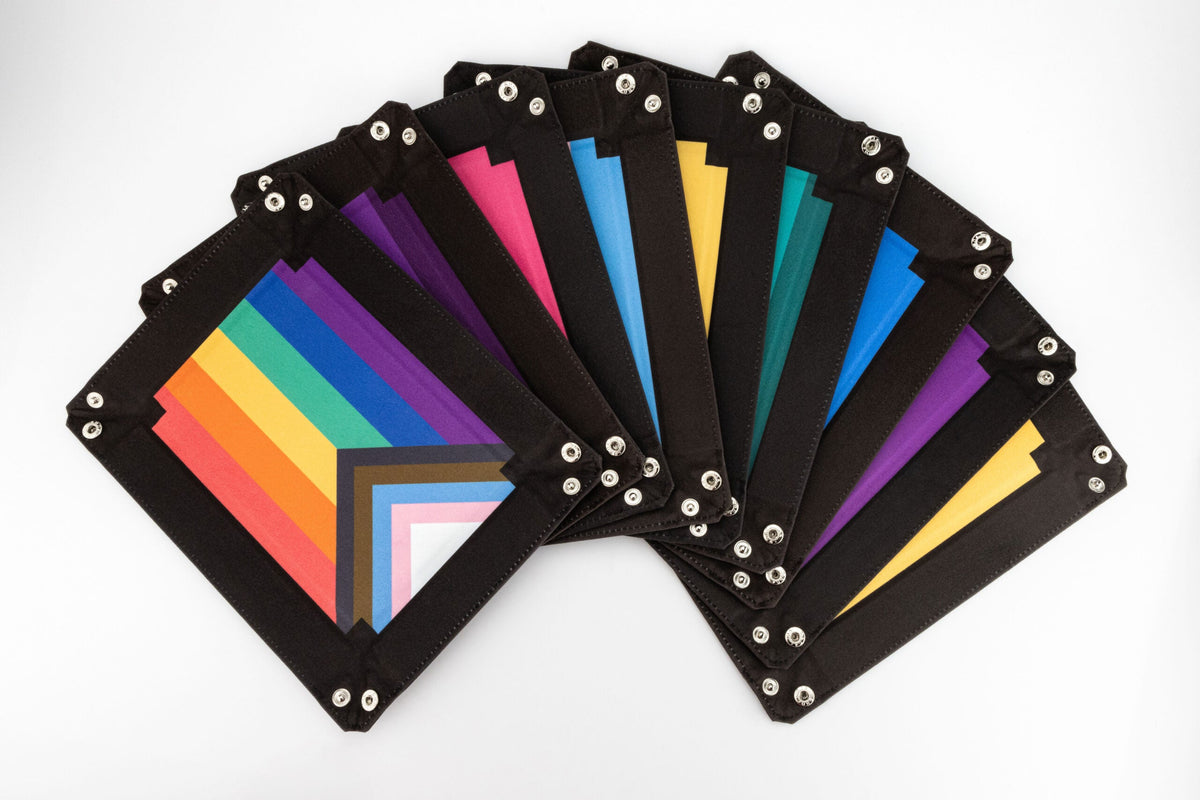
Pride flags are flags that stand for the LGBTQIA+ community or for one sexual orientation or gender identity within it, and their meanings live in the colors: each stripe was picked by the flag's designer to stand for a group of people or an idea. Gilbert Baker's rainbow flag came first, in 1978. Flags for bisexual, transgender, pansexual, asexual, intersex and nonbinary people followed between 1998 and 2014, and we put nine Pride flags on our velvet dice trays.
Pick your flag on our Pride velvet dice tray, or read on for what each flag's colors mean and how we made the trays with Tabletop Gaymers.
The nine Pride flags on our dice trays
Here is each flag on our trays, with who made it and what its stripes mean. Dates and meanings come from Wikipedia's entries on the Pride flag and the rainbow flag.
Rainbow flag and the Progress Pride flag
Artist Gilbert Baker made the rainbow flag, and the first ones flew on June 25, 1978, at the San Francisco Gay Freedom Day Parade. It went on to stand for gay men and then for the whole LGBTQ community. Our rainbow tray uses the Progress Pride flag, which designer Daniel Quasar released in June 2018: the six-stripe rainbow plus a chevron of black, brown, light blue, pink and white for marginalized people of color, trans people, and people living with HIV/AIDS and those who have been lost. Our product pages call this tray the Rainbow Flag, or the Pride Inclusion Flag.

Transgender pride flag
Monica Helms, a transgender woman, designed the transgender flag in 1999, and it first flew at a pride parade in Phoenix, Arizona, in 2000. The flag represents the transgender community and has five stripes. Helms described the light blue stripes as the traditional color for baby boys, the pink stripes as the traditional color for baby girls, and the white stripe in the middle as the stripe for nonbinary people and people who feel they don't have a gender. The pattern reads correctly whichever way up you fly it.
Lesbian pride flag
No single lesbian flag has been adopted by everyone. Ours is the orange-pink flag, which blogger Emily Gwen introduced on Tumblr in 2018. It was modeled on an earlier seven-band pink flag, and its stripes run from dark orange through white to deep rose.

Gay men's pride flag
Rainbow flags have stood for gay men since 1978. Since the 2010s, several flags have been proposed for gay men in particular, and the green, blue and white design on our tray is the one most common today. Its stripes run from deep green and teal, through white, to blue and indigo.

Bisexual pride flag
Activist Michael Page designed the bisexual flag and introduced it on December 5, 1998. It has a broad pink stripe on top, a broad blue stripe on the bottom, and a narrow purple stripe between them. As Page described it, pink stands for sexual attraction to the same sex only, blue for sexual attraction to the opposite sex only, and purple, where the two overlap, for attraction to both.
Pansexual pride flag
The pansexual flag appeared on a Tumblr blog in October 2010. Its three bars are pink, yellow and blue: pink for attraction to women, blue for attraction to men, and yellow for attraction to everyone else, such as nonbinary people.
Intersex pride flag
Morgan Carpenter of Intersex Human Rights Australia created the intersex flag in July 2013, as a design that was not derived from other flags. It is a purple circle on a yellow field. The organization describes the circle as unbroken and unornamented, and says it stands for wholeness and completeness.
Nonbinary pride flag
Kye Rowan created the nonbinary flag in 2014. Yellow stands for people who identify outside the gender binary, white for nonbinary people with multiple genders, purple for people whose gender is a mix of male and female, and black for agender people.
Asexual pride flag
A user called standup on the Asexual Visibility and Education Network made the asexual flag in August 2010, as part of a community effort to choose a flag. Black stands for asexuality, gray for gray-asexual and demisexual people, white for allies, and purple for community.
Pride flags at a glance
| Flag | Made by | Year | Colors |
|---|---|---|---|
| Rainbow | Gilbert Baker | 1978 | Red, orange, yellow, green, blue, violet |
| Bisexual | Michael Page | 1998 | Pink, purple, blue |
| Transgender | Monica Helms | 1999 | Light blue, pink, white |
| Pansexual | A Tumblr blog | 2010 | Pink, yellow, blue |
| Asexual | AVEN user standup | 2010 | Black, gray, white, purple |
| Intersex | Morgan Carpenter | 2013 | Purple circle on yellow |
| Nonbinary | Kye Rowan | 2014 | Yellow, white, purple, black |
| Progress Pride | Daniel Quasar | 2018 | Rainbow with a black, brown, light blue, pink and white chevron |
| Lesbian (orange-pink) | Emily Gwen | 2018 | Oranges, white, pinks |
| Gay men's | Several proposals | 2010s | Greens, white, blues |
Every flag in this table except the plain six-stripe rainbow is on one of our trays; the rainbow appears inside the Progress Pride design.

What the rainbow flag's colors mean
Baker gave every stripe of his first flag a meaning: pink for sexuality, red for life, orange for healing, yellow for the sun, green for nature, turquoise for art, indigo for harmony and violet for spirit. Pink was dropped early because the fabric was hard to find, and later versions settled on the six stripes most people know: red, orange, yellow, green, blue and violet.
That six-stripe version is the traditional pride flag most people picture, and it is the base that the Progress Pride flag and most newer rainbow designs build on.

Other Pride flags you may see
Beyond the nine on our trays, a few more flags turn up at Pride events and online:
- Philadelphia pride flag. The city of Philadelphia adopted it in June 2017. It adds black and brown stripes above the six colors to draw attention to people of color in the LGBTQ community.
- Baker's nine-stripe flag. Gilbert Baker made it in March 2017, adding a lavender stripe for diversity.
- Victory over AIDS flag. In the early years of the AIDS pandemic, activists added a black stripe across the bottom of the six-stripe rainbow.
- Intersex-inclusive Progress Pride flag. In 2021, Valentino Vecchietti of Intersex Equality Rights UK added a yellow triangle with a purple circle to the Progress Pride chevron.
- Aromantic pride flag. Cameron Whimsy created it in 2014: green and light green for aromanticism and the aro-spectrum, white for non-romantic forms of love such as friendship and family, and gray and black for the sexuality spectrum.
How we made our Pride dice trays
When we started on our Pride line, our owner, Neal Hoffman, asked the nonprofit Tabletop Gaymers for advice, so the trays would respect the flags they carry. Its mission is promoting diversity, equity and inclusion by championing the visibility and recognition of the LGBTQIA+ community through tabletop gaming, and our Pride product pages state that a portion of proceeds goes to the group. Read who Tabletop Gaymers are and how they run queer-led events at Gen Con.
Each tray carries one flag across its whole rolling surface, so your flag faces you every time the dice land. The same nine flags come as sharp-edge silicone sets, listed in our post on Pride dice, and every Pride piece we make is in our Gaymers Pride collection.
What the trays do at the table
A Pride tray is a working dice tray first. The velvet surface is padded, so dice don't bang on a hard table, and the PU leather frame snaps into shape for a session and folds flat after. Unfolded, it measures 11 by 8.5 inches and slides between books in a bag.
The padding matters most for fragile dice. A gemstone set or a set of sharp-edge dice can chip on a bare table, and our post on why you need a dice tray covers the rest. Between games, our guide to how to store dice by material helps, and the rest of our range is on our DnD dice home page.
Pride flag questions
What do the colors of the pride flag mean?
On Gilbert Baker's original rainbow flag, pink meant sexuality, red life, orange healing, yellow the sun, green nature, turquoise art, indigo harmony and violet spirit. Today's six-stripe flag uses red, orange, yellow, green, blue and violet.
What is the Progress Pride flag?
It is a 2018 redesign by Daniel Quasar that adds a chevron of black, brown, light blue, pink and white to the six-stripe rainbow, for marginalized people of color, trans people, and people living with HIV/AIDS and those who have been lost.
Who designed the first pride flag?
Gilbert Baker. The first rainbow flags flew on June 25, 1978, at the San Francisco Gay Freedom Day Parade.