
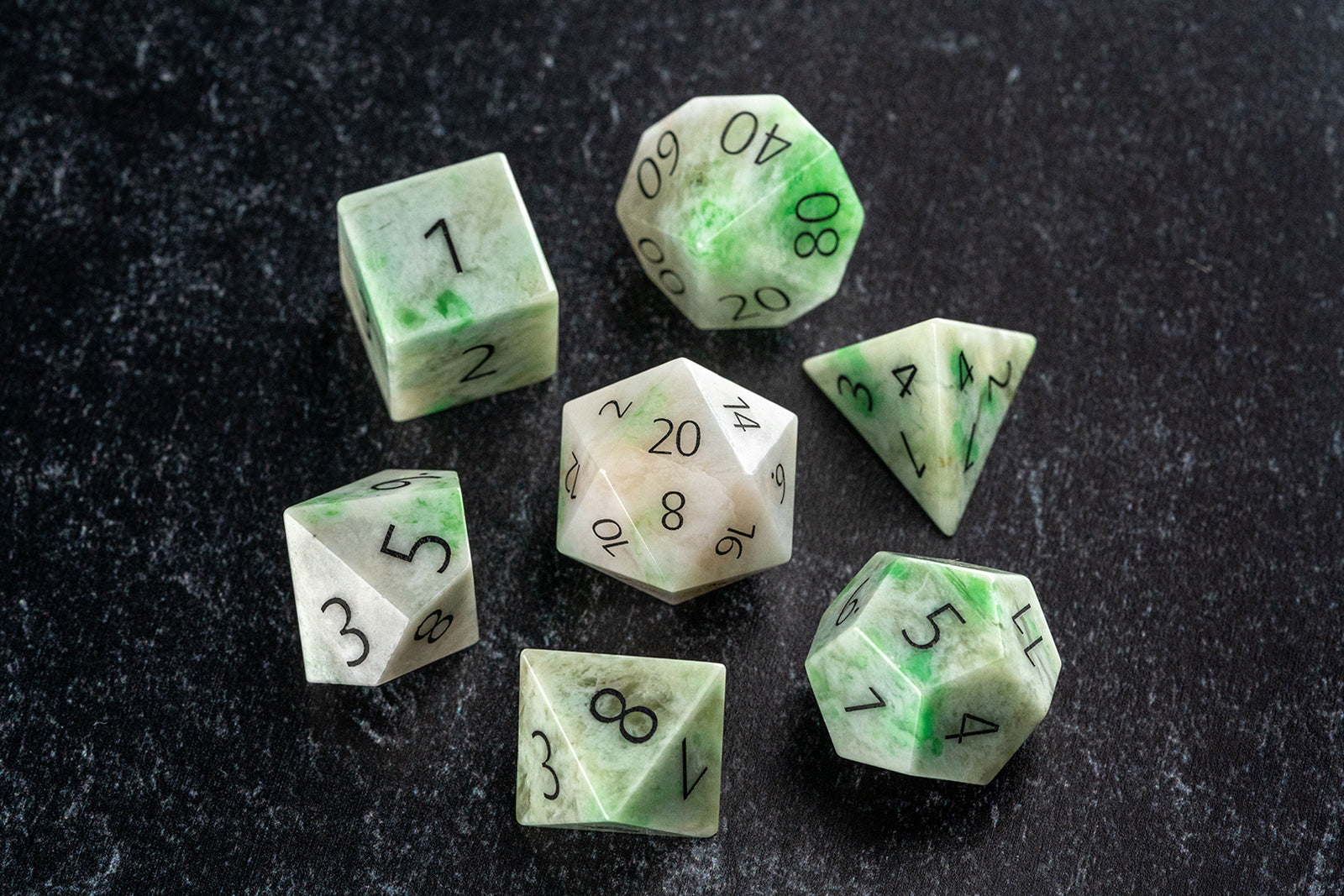
Gemstone dice are dice carved from natural stone instead of molded from resin or cast in metal, made for D&D, Pathfinder and other tabletop games that use a poly set. Pick one up and the difference is obvious. A gemstone d20 has real weight, and the color and pattern run all the way through the die instead of sitting in a pour of resin.
This guide is for players and collectors thinking about their first gemstone dice set, or trying to work out which "gemstone dice" are real stone and which are glass dice. We cover what our sets are made of, what they weigh, how hard the stones are, why the price is higher, and how to keep them from chipping. It all comes from our own product pages and published mineral data, so you know what you are getting before you order.
What are gemstone dice?
Gemstone dice are natural stone dice: polyhedral dice cut from real rock instead of plastic. Our gemstone dice and stone dice sets are precision carved from stone, then numbered. The full-sized 16mm stone sets in stock right now are tiger's eye and blue tiger's eye at $84.99, rose quartz at $69.99, and K2 stone and imperial stone in purple, blue and red at $99.99. All of them have engraved numbers. For dice that hold an actual piece of history, such as a meteorite fragment, see our Roll with History dice with Mini Museum.
Every one of those is a standard poly dice set with 7 dice: d4, d6, d8, d10, d10 (00 to 90), d12 and d20. That is the full kit a D&D character needs, so a gemstone dice set can be your main dice for a whole campaign, not just a display piece. For the same 7-piece set in resin, metal and other materials, see our DnD dice.
Because each die is cut from natural stone, no two sets look exactly alike. The color and patterns you get are the ones that piece of stone had, which is a big part of their beauty and a big part of why collectors love them. Every stone also carries its own geological story, from quartz to the K2 stone mined on the second highest mountain in the world.
How are natural stone dice made?
Here is how our stone dice are made. Each die is precision carved into its shape, d4 through d20, and then numbered. Some sets get printed numbers. Engraved sets have the numbers cut into the face. Every finished dice set is shipped in a resin case that separates each die for protection, so it arrives packaged and ready to give as a gift.
That carving is the big difference from how resin dice are made. Resin is poured into a mold. Stone has to be cut, which is why every gemstone die is a crafted piece rather than a casting, and why quality comes down to the hands doing the carving. Hand crafted stone is also why no two orders look the same.
Real gemstone dice vs glass dice
This one trips people up, so here is the straight answer.
Most of the items in our gemstone collection are real stone. A few sets that sit in the same collection are glass dice, and we label them that way:
- Zircon Glass birthstone dice. These are carved from zircon glass and made to resemble each of the 12 birthstones, with engraved gold numbers. The July Ruby set looks like ruby, but it is zircon glass. It is $74.99, and it is the only birthstone set in stock right now. We have 3 left. If a July birthday is on your gift list, order the July Ruby set now.
- Rainbow Prism Glass. Our Engraved Rainbow Prism Glass set is $74.99 and is made to reflect color as it hits the light.

These sets are still a beautiful choice, and they make a good birthday gift. Just know what you are buying. If you want real stone, review the product title, the photos and the collection notes before you add a set to the cart or place an order. Stock on individual stones changes often, so if your favorite is out of stock, check back or shop a similar stone in the same color.
How much do gemstone dice weigh?
A full 16mm gemstone dice set weighs about 4 ounces (113 grams), which works out to roughly 16 grams per die. For comparison, a resin dice set weighs about 1 ounce and a metal dice set about 8 ounces. So gemstone sits in the middle: about four times the weight of resin and half the weight of metal. Our dice weight guide has the full material by material breakdown.
That middle weight is a big part of the appeal. You notice a gemstone d20 in your hand before the roll, but it won't feel like you are throwing a sinker the way a big metal set can.
Weight also varies by material. Wikipedia's mineral data puts quartz at a specific gravity of 2.65 and hematite at 5.26, so hematite is about twice as dense as quartz. A die cut from a dense stone feels heavier in the hand than a rose quartz die of the same size.
How hard are gemstone dice? Hardness is not toughness
The Mohs scale ranks minerals by scratch resistance: a harder material scratches a softer one. Talc is 1, quartz is 7 and diamond is 10. Glass rates about 5.5.
Several of our stones are forms of quartz. Rose quartz and tiger's eye are quartz varieties. That makes them harder than glass.

Here is the catch. Hard is not the same as tough. Hardness tells you what can scratch a die. It doesn't tell you whether the die will chip or crack when it lands. Hematite rates 5.5 to 6.5, and it is also classed as brittle. A phone screen works the same way: it shrugs off keys in your pocket and still shatters when you drop it.
So treat every gemstone dice set as something that can chip on a hard landing, no matter where it sits on the scale. Natural stone is durable against scratches but more fragile than resin when it hits something hard.
Are gemstone dice worth it?
They are worth it if you want dice with real weight, natural color and a crafted look, and you are willing to roll them with a little care. A few reasons players pick gemstone dice:
- The feel. Stone has a hefty feel that resin can't match, so a big roll feels like a big roll.
- The look. Natural color and pattern, no two sets identical. Every die is a small piece of the stone it came from, and a beautiful thing to hold. Collect a few sets and you have a whole shelf of color.
- A character match. Blue tiger's eye for the wizard, tiger's eye for the ranger, red imperial stone for the warlock. Picking a style and color to fit a character is half the fun.
- The gift. A gemstone dice set is a step up for the player who already owns a bag full of resin. The case it comes in keeps each die in its own slot, so there are no loose things rattling in the box.
- The style. Stone dice have a style all their own on the table, more understated than glitter resin and less flashy than metal.
When to roll them
You don't have to roll stone for every attack. One approach we like: keep a resin dice set for the everyday rolls and bring out the gemstone d20 for the moments that matter, like a death save, the boss fight or the last roll of a long campaign. A DM can do the same behind the screen, saving a stone d20 for the villain's big moment. Between sessions, a gemstone dice set looks good on a shelf as a display piece.
Gemstone dice are not the right pick if your group rolls hard onto a bare wooden table or tosses dice through a tower every turn. And no material changes your odds. A gemstone d20 will not give you more nat 20s, and nobody should promise you that it will.
Why do gemstone dice cost more?
Material and work. The price of a gemstone dice set reflects both. Each die is carved and finished, which takes more time than pouring resin into a mold. Engraved sets add another step. You are paying for the stone itself and for the crafted work of the hands that cut and number it, and the quality of that work is what you see on the table. Our engraved stone sets run from $69.99 for rose quartz to $99.99 for K2 and imperial stone.
Our gemstone dice sets
A few favorites to start with:
- Engraved Tiger's Eye, $84.99. A quartz variety, with engraved numbers. The Engraved Blue Tiger's Eye is the same price.
- Engraved Matrix Tiger's Eye, $99.99. We have 2 sets left. If this is the tiger's eye you want, add the Matrix Tiger's Eye set to your cart today.
- Engraved Rose Quartz, $69.99. Another quartz variety, with engraved numbers.
- Engraved Purple Imperial Stone, $99.99. Imperial stone also comes in blue and red at the same price, so you can match a party.
- Engraved K2 Stone, $99.99. The product page notes that K2 stone is mined from K2, the second highest mountain in the world.
- Mystic Mines Misfit Gemstone Dice Set, $49.99. A blind box with a random set of 7 gemstone dice, which the product page says came straight from the Dwarven mines. It can include anything from opalite to amethyst, plus stones like obsidian, labradorite and coral fossil, and some dice may have minor issues like off center or scratched numbers. If you like a mystery and don't need a matched set, it is the lowest price way into stone.


The full gemstone collection shows every stone we make, and each product page shows whether that set is in stock.
Some players also choose stones for the meanings attached to them. That is a personal call, and we leave it to you. Before you order, review each product page; it lists the stone, the size and whether the numbers are printed or engraved.
How to care for gemstone dice
Gemstone needs the most care of any dice material, because it can chip on a hard landing. Every one of our stone product pages carries the same recommendation: roll them on a padded surface. That recommended setup is the single best thing you can do for a stone set.
- Roll on a dice tray. A padded dice tray gives stone a soft place to land. Our Gen Con 2022 Dice Tray is velvet, folds flat and costs $17.99. Skip bare wood, stone countertops and glass tables.
- Roll one or two at a time. A fistful of gemstone dice knocking together is how corners chip.
- Use the case. Every gemstone dice set comes in a resin case that separates each die for protection. Keep them stored in that box between sessions.
- Store stone apart. Heavy dice chip lighter ones in a shared bag, and harder stones can scratch softer ones. Keep stone and metal away from resin, and give each gemstone dice set its own space, like our Snowflake Velvet Dice Bag with satin liner at $4.99.
- Keep them away from small children. Gemstone dice are small, hard and heavy, so treat them like any small items around kids.
- Keep it simple when cleaning. For cleaning by material, read our dice care and maintenance guide.
Gemstone dice FAQ
Are gemstone dice real gemstones?
Most of ours are real stone, carved from materials like tiger's eye, rose quartz, K2 stone and imperial stone. The Zircon Glass birthstone sets and the Rainbow Prism Glass set are glass, and we say so on the product pages.
Are stone dice heavy?
Heavier than resin, lighter than metal. A full 16mm gemstone dice set is about 4 ounces, compared with about 1 ounce for resin and about 8 for metal.
Do gemstone dice chip?
They can. Stone is hard, but hardness only measures scratch resistance. A drop onto a hard table can chip a corner, so roll them on a padded dice tray and store each die in its slot.
Can you use gemstone dice for D&D?
Yes. Each full-sized dice set has all 7 dice a character needs, from the d4 to the d20, plus the percentile d10. You can use a gemstone dice set as your main dice and keep a resin set as a backup for the nights the table is bare.
Is the ruby birthstone set real ruby?
No. Our July Ruby birthstone set is zircon glass made to resemble ruby, not cut from ruby. It is $74.99, and we have 3 left.