The best dungeon master tips are about the hours around the game as much as the game itself: what you prepare, how you keep the table moving, and what you do once everyone has gone home. Here is what we would tell a new DM, in the order you will need it. New players at the table can read the DnD dice guide before session one.

Before the session
Prep one page, not a novel
Writing your own adventure takes time. Wikipedia's entry on the Dungeon Master notes that a custom adventure can take several hours of preparation for every hour of play. A published adventure cuts that down. Either way, boil your notes down to one page: the opening scene, three names you can drop in, one fight, and one secret the players can find. If it does not fit on the page, you will not use it on the night.
Know the one rule that runs everything
You do not need to memorize the books. The core of the game is the D20 Test: a player rolls the d20, adds modifiers, and succeeds if the total meets the target number you set. The free D&D rules put it plainly: a player rolls whenever their character tries something the DM decides has a chance of both success and failure. If nothing is at stake, skip the roll and say what happens.
Set the table before anyone arrives
Put a dice tray in the middle, a spare 7-piece set where a new player can reach it, and a few extra d6s for the monsters. Spare sets for the table are in our DnD dice range. When you know which spells and weapons your players use, our post on what dice each player needs tells you how many to have on hand. A pound of dice covers the loaner pool for every player who forgets theirs.
At the table
Start in the middle of something
Skip the long walk to the dungeon. Open on a moment that asks the players to choose: the cart has lost a wheel and something is moving in the trees. Everyone at the table should have a reason to act inside the first few minutes.
Describe, ask, then let the dice decide
Your job is to describe what the characters perceive and what their actions change. The players decide what their characters do. A simple loop keeps it clean: describe the scene, ask "what do you do?", and call for a roll only when the outcome is in doubt.
Make a ruling now, look it up later
The DM is the referee, teaching the rules and applying them. When a rules question comes up mid-fight, make a fair call, note it, and check the book after the session. A five-minute search for the right page costs more fun than a slightly wrong ruling.
Give every player a turn in the light
A quiet player may have an idea nobody has heard yet. Every scene or two, ask a player who has not spoken what their character is doing. Combat already has an order; the scenes between fights need you to make one.
Pick open rolls or hidden rolls and stay consistent
Some DMs roll in front of the players so nobody doubts the dice. Others roll behind a screen or into a dice tower so they can keep a surprise. Both work. Tell your table which you do, and do it the same way every time.

Between sessions
Ask one question
Before people leave, ask what they enjoyed most. You will learn more from the answer than from any guide, this one included, and it tells you what to give them more of next time.
Write down every name you made up
The innkeeper you invented on the spot will come back, and your players will remember her name even if you do not. Keep a running list of characters, places and promises, and read it before you prep the next session.
Plan from what the players chose
The best next session usually grows out of the last one. If the party spared the bandit leader, he has friends; if they burned the bridge, the long road is now the only road. Choices that change the world are what make players feel the game is theirs.
Gear that earns a spot behind the screen
A DM's kit does not need to be big. These are the pieces we would bring to every session:
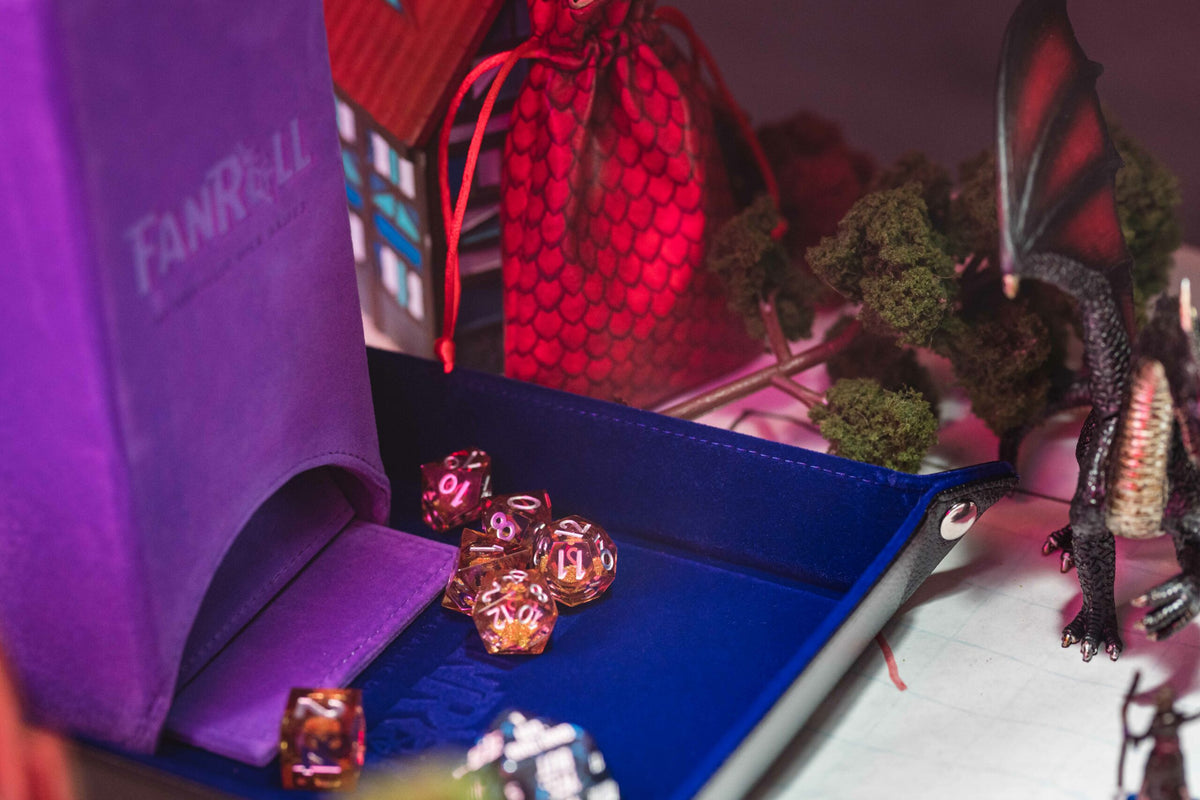
- A dice tray in the middle of the table. It keeps every roll in one place and protects the table, which matters as soon as someone brings metal dice. Ours fold flat to fit in a folder or backpack, then snap into shape; the velvet tray measures 10 by 10 inches unfolded.
- A dice tower for hidden or dramatic rolls. You drop the dice in the top and they tumble out the bottom. Our fold-up dice tower folds flat and snaps into shape with magnets.
- A spare set for new players, so nobody spends their first session borrowing.
- A mini set in your bag for one-shots on the road. Ours are 10mm and fit in a pocket.
Start with the tray: browse our dice trays, from velvet with leather backing to the D&D Masterworks Series with art by Erol Otus, Jeff Easley and Larry Elmore, all made by FanRoll, making dice since 2014. Here is why a tray belongs at every table, and the story behind the Masterworks towers and trays.

Running games for a school or a new group? See how to start a D&D club and running tabletop RPGs for young players.
DM questions, answered
What does a Dungeon Master do?
The Dungeon Master runs the game. They describe the world and what the characters experience, play every character the players do not, set the challenges, and referee the rules. The title comes from TSR, which introduced it in the Blackmoor supplement in 1975. Other games call the same job the Game Master or GM.
How do you get started as a Dungeon Master?
Read the free D&D rules, pick a short published adventure, and invite a few friends for a one-shot of two or three hours. Prep one page, keep the rules light, and make rulings instead of searching books. Your first session does not need to be good; it needs to happen.
Is it hard to be a Dungeon Master?
It is more work than playing, mostly in preparation, but it gets easier fast. A published adventure takes much of the prep off your plate, and the one rule that matters most, the D20 Test, takes a minute to learn. The rest you will pick up at the table.